



After completing the lesson students will be able to
- talk about people, places and familiar objects in short and simple sentences
- ask and answer questions
- participate in short dialogues and conversations on familiar topics
- read and understand texts
- write short paragraphs
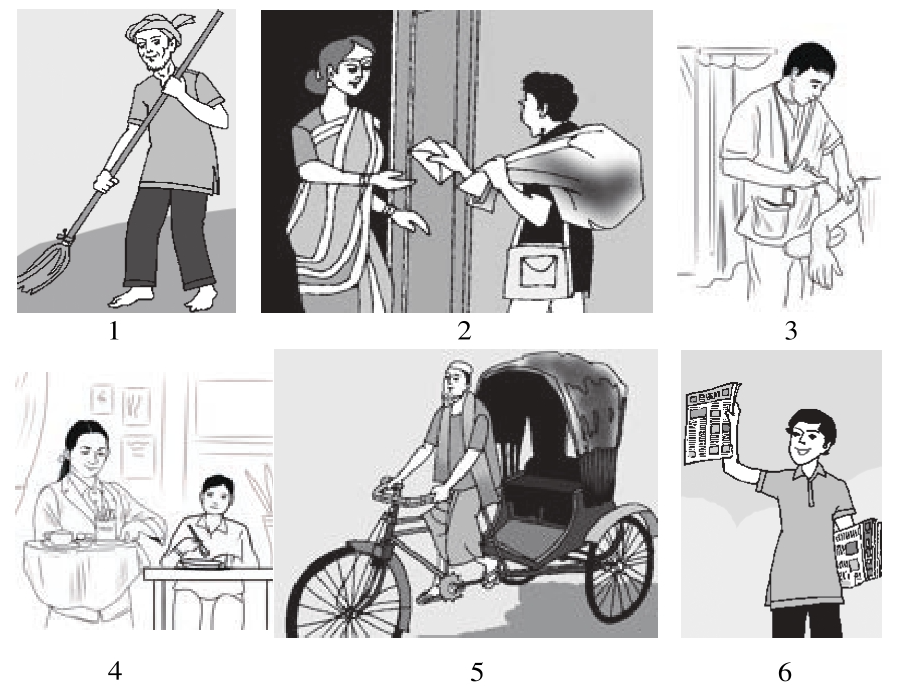
A . Look and say. Use suitable words from the box to describe the occupation of each person below.
newspaper hawker nurse cleaner rickshaw-puller waitress postman |
A1 . Choose appropriate words from the box to complete the dialogue below. Then act out the dialogue in pairs.
| letters | restaurant | streets | place | morning |
A : What does a cleaner do?
B : A cleaner cleans our houses, office and _______ etc.
A : What does a newspaper hawker do?
B : A hawker gives us newspapers every_________
A : What does a postman do?
B : A postman delivers ______ and other items to us.
A : What does a rickshaw puller do?
B : A rickshaw puller takes us from one ___________ to another.
A : What does a waiter do?
B : A waiter serves food at the __________
B Read the text about Bulbul and answer the questions below.
Bulbul collects rubbish from the Sankar area in Dhaka. Every morning, he wakes up at 5 o'clock and walks along the streets of Sankar to collect rubbish. People of Sankar put their rubbish in plastic bins and leave them in front of their houses. Bulbul walks from door to door to collect them. Sometimes the bins are very dirty and they smell bad. But Bulbul does not mind. He takes out everything from the bins and puts them in his van. He believes that all jobs are important. He works hard every day to keep this area clean.
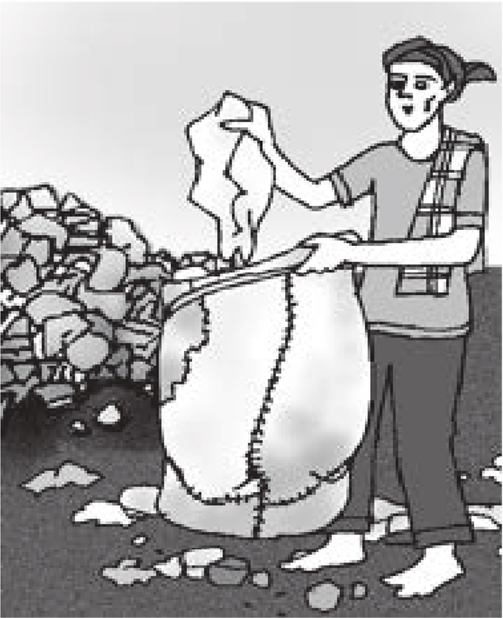
Last month Bulbul was sick for two days. So, he could not come to collect the rubbish. The people of Sankar were in great trouble. They got piles of rubbish waiting in front of their houses. The whole area became dirty and unhygienic. When Bulbul got well, he came back to Sanker. He collected everything from all the bins. Bulbul does not want to fall sick again. He realises, if he stops working even for a few days only, the whole area will turn into a big dustbin.
B1 . Now, ask and answer the questions in pairs.
a) What time does Bulbul wake up?
b) Where do the people of Sankar put their rubbish?
c) Why does Bulbul think that all jobs are important?
d) What happened when Bulbul became sick?
e) What will happen if Bulbul falls sick again?
f) What will you say to Bulbul, if you meet him?
B2 . Think of a person who helps you live well. Write a composition on this person. Now, answer the following questions.
a) What does he/she do?
b) How does his work help you live well?
c) What time does he/she start his/her work?
d) How does he/she do the work?
e) Does he/she like the job? Why/why not?
f) What will happen if he/she stops working?
g) What do you think about his/her job?
Language Focus:
| Notice the verbs in the italics in the following sentences. a) Bulbul collects rubbish from the Sankar area in Dhaka b) Every day he wakes up at 5 o'clock and walks along the streets of Sankar. We talk about usual routines in simple present tense. In simple present tense, the verb takes an 's' or 'es' if the subject is any one person/he/she etc. |
| Notice the verbs in the following sentences in italics. a) The people in Sankar area became very upset. b) They got piles of rubbish waiting outside their house. All the sentences here talk about the past. So, they are in simple past tense. In simple past tense, the verb is always in its past form (e.g. got, became, etc.). |
B3 Underline all the verbs in text on Bulbul (B). Write down the past form of the verb in the present tense. Also write down the present form of the verb in the past tense.
One is done for you.
wakes up ______ woke up.

Read more